
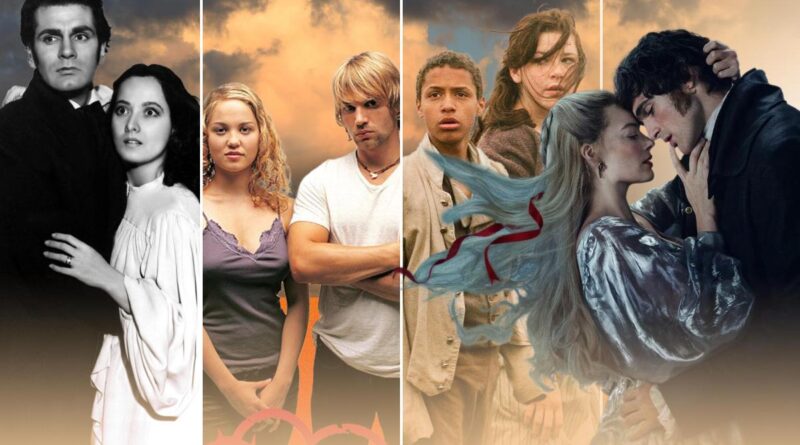
NÃO PERCA: Version Control: Which Version of ‘Wuthering Heights’ Will Make You Swoon? 🍿
Remakes, reimaginings, and readaptations have been a part of the movies as long as the medium has existed. With the series Version Control, Jesse Hassenger explores stories with multiple notable incarnations throughout cinema history, to help determine which movie version may be right for your streaming needs.
Emily Brontë only published a single novel in her lifetime — her sister Charlotte published several — but it’s hard to beat that single book’s impact. Wuthering Heights, first published in 1847 under a pseudonym, has become an undisputed classic of English literature, a constant classroom presence and oft-reread favorite that also, naturally, has inspired its share of adaptations in movies and TV. Perhaps more than its share, actually; between theatrical films, TV movies, and miniseries, there are dozens of versions to choose from. The recent Vulture ranking of 32 such iterations doesn’t even cover them all, because there are some versions (like a 1920 silent film) that are outright lost to history or effectively impossible to track down.
So how to choose among those that you can actually watch? Let’s assume the new film of Wuthering Heights, a splashy and IMAX-ready production featuring Margot Robbie and Jacob Elordi, as a crucial comparison point; it’s the highest-profile adaptation in a good long while, and given its box office success, it seems likely to be the defining 2020s adaptation whether you like it or not. Like a lot of other adaptations, Emerald Fennell’s new film focuses on the characters of Catherine and Heathcliff, who meet as children when Catherine’s father unofficially adopts Heathcliff into their downwardly mobile family home on the moors of Yorkshire (the crumbly estate is the titular heights). They’re bonded together inextricably, yet Heathcliff’s low social stature keeps Catherine from fully giving in to her true love. Instead, she looks across the moors to a wealthier family she marry into. Heathcliff suffers abuses (in Fennell’s film, at the hands of his adoptive father; in the book, it’s Catherine’s jealous brother), leaves to make his fortune, returns, and from there, different versions have different mixtures of love, sex, obsession, revenge, tragedy, and traumas visited upon future generations.
The broad outlines are often similar, with details frequently changed — and one major alteration that many of the most famous versions have in common. Like so many before her, Fennell stops short of including the book’s less frequently adapted second-generation story following the children of these characters. (One considerable drawback: It does eventually involve developing romantic feelings between cousins.) So for the sake of apples-to-apples comparisons, we’ve chosen three other versions that share this more limited frame to compare across the years. (There is a 1992 version with Ralph Fiennes and Juliette Binoche that does include the next-gen story, and still somehow gets it all done in 105 minutes.)
And just as the current Wuthering Heights seems to be the de facto version of the 2020s, the other three versions compared here represent other distinctive decades, for better and worse. So let Version Control take you through four different blustery, damp moors in search of your perfect Catherine and Heathcliff.
-
The other versions on this round-up will be more recent, but to some extent they exist in the shadow of this 1939 classic, long considered a definitive adaptation not so much in terms of fidelity to the literary source, but in Classic Hollywood craft: It’s directed by William Wyler, who also made, among others, The Best Years of Our Lives, Roman Holiday, and Ben-Hur, and collected a dozen Best Director Oscar nominations over the course of his career, including for this film. He didn’t win (for this one, anyway), but Gregg Toland, the cinematographer who shot Citizen Kane, did take home an Oscar, and you can see why; beyond the rich black-and-white images themselves, bringing out a gothic sensibility compatible with classics like Rebecca, there are some gorgeous camera movements in this version, pushing in and out of the estate where Catherine (Merle Oberon) and Heathcliff (Laurence Olivier) make their early home. This version makes more use of a framing device and teases out the idea of ghosts haunting the moors, not as a primary concern but nonetheless in a more vivid way than many other more strictly realistic adaptations.
Despite the legendary Olivier, though, this Wuthering Heights is more notable for those visual and mood touches than the actors truly bringing the characters to life. (Like so many adaptations, the actors are hovering around 30 when playing characters who even in their “adult” guises should be nearly a decade younger.) The question of Heathcliff’s racial background comes up repeatedly in modern discussions about Wuthering Heights, though most adaptations (including the newest one!) nonetheless just cast a white guy; Wyler’s version is sort of interesting in retrospect for actually casting a mixed-raced actress as Catherine, though Merle Oberon’s Anglo-Indian background was not actually known at the time and doesn’t really read as “othered” in the way that Heathcliff is supposed to. She does give some impressive white-girl crazy eye, though! This is a thoroughly well-appointed, technically impeccable, entertaining, and fairly concise adaptation of the most well-known portion of Brontë’s book; it’s just missing some kind of ineffable passion or grit to make it feel like more than a polished Old Hollywood prestige picture (and to be clear, that ain’t hay!).
-
OK, we admit that this 2003 MTV production that never played in movie theaters is not exactly one of the most prestigious variations available. That said, does something even count as a work of globally famous classic literature if there isn’t a teen-movie version of it?! There have been several teenage takes on Wuthering Heights over the years, but it’s impossible to resist one that aired just after the turn-of-the-millennium teen-movie boom, featuring a butt-rock Heathcliff and a Catherine played by Swimfan. Or, more accurately, it’s impossible to resist until you actually watch it, at which point it becomes highly resistible; this incarnation is absolutely terrible, taking the question of whether the filmmakers read the book (or even saw one of the other movies) to new, well, heights. Here, Heath (Mike Vogel) and Cate (Erika Christensen) have a less charged, ambiguous relationship; despite being brought up as sorta-sibs, they have a pretty typical high school romance by the time… well, I was going to say graduation rolls around, but no one in this movie spends very much time at school. Also, Wuthering Heights is now a lighthouse, and the characters are now mainly idiots.
Apart from cosmetic changes that happen to render certain aspects of the story incomprehensible, the basic events of the movie are more or less faithful to the broad outlines of the Catherine-and-Heathcliff portion of the novel — which actually makes the movie feel more nonsensical. The most enjoyable aspect is probably Katherine Heigl’s unhinged performance as Isabel, Cate’s potential sister-in-law who Heath courts for revenge when Cate shacks up with Edward (Christopher Kennedy Masterson). There are lots of different interpretations of this character, but no others I’ve seen involve her serving as a Svengali for a terrible music career, complete with early-2000s message-board buzz (she’s really horning in on Swimfan’s territory here). Despite and/or because of the involvement of famed songwriter Jim Steinman (most famously a collaborator of the singer Meat Loaf), the music in this near-musical is hilariously bad (though to be fair, Steinman has a story credit, rather than supplying a bunch of original songs). By the time Cate staggers over to a beachy cave to give birth, the movie has sunk below the levels of a dumb music video.
-
As mentioned, there’s been plenty of discussion of Heathcliff’s racial background in the original novel; a recent Vulture report sums up the various points of view. Basically, the writing styles and social mores of 1847 make it difficult to discern whether Heathcliff is intended to be genuinely dark-skinned, merely swarthier than his pasty makeshift family, or othered more by his class than his literal physical appearance. He’s a “dark” character with all of the intrigue and vagueness that implies. So it’s both bold and entirely textually justified that filmmaker Andrea Arnold flat-out made Heathcliff Afro-Caribbean in her stripped-down 2011 version of Wuthering Heights, played by Solomon Glave in his younger years and James Howson as a young adult. While she’s at it, Arnold reorients the story to be told almost exclusively from Heathcliff’s point of view; there are few if any scenes featuring Catherine (Shannon Beer, then Kaya Scodelario) that aren’t experienced through his eyes (at least metaphorically).
There’s a more subtle structural casting change here, too: While other versions tend to switch over to the “main” adult actors for Catherine and Heathcliff as soon as the characters are plausibly (or even not-so-plausibly) grown, Arnold holds off and doesn’t swap out the younger stars until Heathcliff returns after a multi-year absence. This might just sound like basic sense, but it certainly isn’t the case with Hollywood takes, and here gives the time-jump a much bigger emotional impact. Arnold, who made the terrific coming-of-age pictures Fish Tank and American Honey, seems especially comfortable with the younger performers, and the oft-handheld cinematography from future Yorgos Lanthimos fave Robbie Ryan gives the moors a tactile grit not often seen even in contemporary-made period pieces. This is a dirty, mucky, animal-filled Wuthering Heights, and while it’s not as lush or conventionally entertaining as other versions, Arnold’s imagery-forward, dialogue-light vision feels beholden to no one.
-
Photo: ©Warner Bros/Courtesy Everett Collection Emerald Fennell’s adaptation brought the story back to the top of the box office for the first time in decades, and kicked off additional discussion about how this movie differs from the original text. It feels like a particularly online controversy, though, because most Wuthering Heights adaptations make major changes; if anything, Fennell condenses some material to beef up supporting characters. Nelly (Hong Chau), Catherine’s nanny of sorts, has a more substantial and active role here; Catherine’s brother is eliminated so that her father (Martin Clunes) becomes Heathcliff’s simultaneous benefactor and abuser, a more fraught (and in some ways psychologically realistic) dynamic; and the immature, oft-thwarted desires of Catherine’s rival Isabella (Alison Oliver) are played for kinky comedy.
That last bit has the strongest ring of That’s So Emerald — what fans and haters alike might expect from the Saltburn and Promising Young Woman director taking on a classic. But freed from the seeming obligation to inflate her cheeky pastiches with satirical meaning, the Fennell touch applied to Wuthering Heights feels, to this viewer, far more playful and often Old Hollywood lush, with gorgeous celluloid cinematography from Linus Sandgren, tunes from Charli XCX, and some stunningly ostentatious art direction. If all of these trimmings threaten to overwhelm the central duo of Margot Robbie and Jacob Elordi, well, sort of, but the point of casting overwhelmingly charismatic stars in these roles is that it doesn’t necessarily matter if they’re giving the best performances in the movie or even if they’re the most eye-catching elements on screen. (And sometimes, they totally are, janky ages nonwithstanding.) That’s why it seems beside the point to say that Fennell hasn’t made an especially provocative, explicit, or daring take on Wuthering Heights; no, she’s made an amped-up bodice-ripper (or bodice-tightener) that’s more of a luxed-out version of the 1939 movie than a bold new re-envisioning of the underlying material. In that spirit, isn’t the sexy goop more fun when it’s snuck into what could otherwise be mistaken for a respectable motion picture?
THE VERSION CONTROL VERDICT: WUTHERING HEIGHTS (2011)
All of these except the awful 2003 MTV movie are worth watching, but if you’re going to choose just one, Andrea Arnold’s version feels most fully developed into its own feature that nonetheless attends to the concerns of the novel, rather than a self-conscious literary adaptation.


Jesse Hassenger (@rockmarooned) is a writer living in Brooklyn podcasting at www.sportsalcohol.com. He’s a regular contributor to The A.V. Club, Polygon, and The Guardian, among others.
📢 Gostou da notícia? Compartilhe com os amigos!
Este artigo é uma tradução automática de uma fonte original. Para ler o conteúdo na íntegra: Clique aqui.