
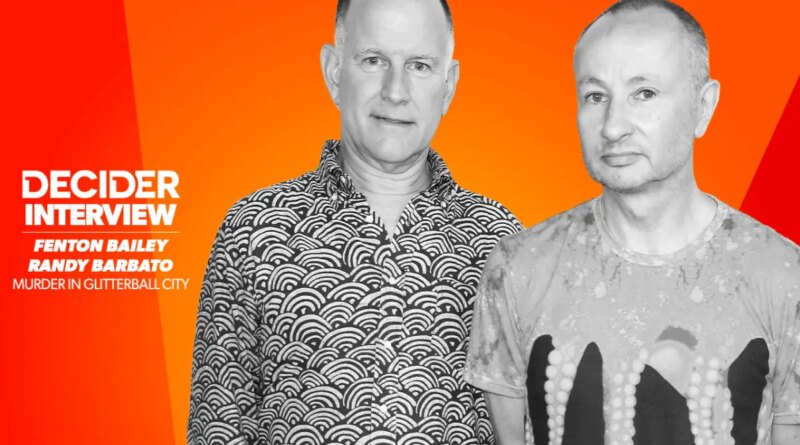
NÃO PERCA: ‘Murder In Glitterball City’’ Directors Fenton Bailey And Randy Barbato Address The Doc’s Chilling Ending: “Both Should Be In Prison” 🍿
HBO‘s new true crime documentary Murder In Glitterball City begins with a chilling home video that looks like a murder confession, leading the viewer to believe this murder is an open and shut case. But the two-part documentary, directed by World of Wonder founders Randy Barbato and Fenton Bailey, peels back the layers of the complicated couple at the center of this murder to reveal the answer isn’t so easy after all.
Despite having access to thousands of personal text messages and hours of recordings and footage taken by the couple, Barbato told DECIDER, “It became pretty clear to us we were never going to know precisely what happened in that room. But we might be able to shed more light on it.”
Based on the book A Dark Room in Glitter Ball City by Daniel Dominé, the new doc dives into the 2010 murder of beloved local drug dealer, hairstylist and drag queen James Carroll, whose body was found stuffed in a rubbermaid bin buried in Joey Banis and Jeffrey Mundt’s basement. The chilling discovery left their Old Louisville neighborhood and the local gay community shaken. When both men begin pointing fingers at each other, two separate murder trials shed light on the toxic relationship at the center of this case.
Their stories largely lined up – both men accused the other of killing Carroll after a night of partying and doing drugs. They both claimed they were in the throes of a threesome when the other began attacking Carroll.
But Murder in Glitterball City attempts to dive into the nuances of this story that complicate the truth. Banis faced more scrutiny due to having a criminal record, but Mundt was also revealed to have his own proclivity for illegal activities. Bailey also told DECIDER that the hours of home footage showed the couple were constantly in a “weird state of reality or surreality” due to crystal meth. But, like most true crime, the case shifted focus from the victim to the suspects.
“People have told versions of this story in the media and on television in the past, but you didn’t learn very much at all about Jamie. And Jamie is really kind of interesting, and people really did love him. And so that was super important to us,” Barbato said.
Even 15 years later, Murder in Glitterball City makes it clear we are no closer to getting to the truth of the case, but we may be able to understand it better for Carroll’s sake.

Murder in Glitterball City also ties in perspectives from local residents, including mediums, business owners, bartenders, drag queens and more, to paint a picture of Louisville’s vibrant queer community to illustrate the culture Mundt, Banis and Carroll were surrounded by at the time.
“Every ghost story is about location in a way. And every murder really is a ghost story because there’s that single event, but then it just iterates out and echoes through time and generations. So, it just felt that to tell this story, it wasn’t just about those three people,” Bailey told DECIDER. “It just felt like part of the fabric of the story.”
Keep reading to learn more about how Barbato and Bailey chose to approach this case in Murder in Glitterball City and their perspectives on where Banis and Mundt are now.
DECIDER: If you could walk me through the very beginning, what was it exactly that made you want to take on Jamie’s story for this documentary?
FENTON BAILEY: I think it was Nancy Abraham and Lisa Heller at HBO sent us the book and said, “Take a look at this,” and we read it. And, on the one hand, it’s a true crime story, and on the other, it’s a queer love story gone wrong. It’s not really Heated Rivalry. And we sort of feel, I think as queer filmmakers, we felt that it would be easy to sensationalize the story or tell it in a way that is maybe slightly homophobic, you know, or sort of lurid. It’s a complicated– it’s a terrible tragedy, and I think terrible tragedies are often very complicated. And we felt we wanted to, as far as possible, just tell the story fully about what happened, because in some ways, that story hasn’t been told because you need someone like HBO Docs where you can have that freedom to go to some uncomfortable places and talk about fairly intimate things, but without being coy and without being sensational.
RANDY BARBATO: After we read the book, we went to Louisville and started to meet a lot of the characters that are in David Dominé’s book and then other characters. We just started meeting this community of people, and they were so interesting and inspiring, and we sort of fell in love with the town and with the community. And then it became kind of clear that, a lot of times when you see a true crime TV show or documentary, they’re sort of very procedural and they’re not personable. […] It’s really the experience of where this took place, how it affected people. It became pretty clear to us we were never going to know precisely what happened in that room, but we might be able to shed more light on it, and we might be able to impact people’s feelings about whether there should be two people in prison instead of just one.
BAILEY: There was a feeling that justice had not been done. And, like Randy was saying in a way that it’s like the glitterball, the disco ball. The way those work it’s like a single beam of light hits it and it just scatters in all directions. And that was sort of that sort of what we were trying to capture, all these different takes and all these different perspectives. Because when there’s a murder, it isn’t just those people, it’s a whole community. And we wanted to convey that.
I felt my heart breaking the more I learned about Jamie from the people who loved him and knew him. And, also on the other side of it, I found myself falling in love with Louisville, and I was like, I have to come see this for myself.
BARBATO: That means so much hearing that because in so many ways, there’s two things. One is people have told versions of this story in the media and on television in the past, but you didn’t learn very much at all about Jamie. And Jamie is really kind of interesting, and people really did love him. And so that was super important to us. And then the fact that you want to go to Louisville… We should have gotten some financing from the tourism board, Fenton.
I know that Jeffrey didn’t respond to requests for comment and for input for the documentary, I believe. But what was it like reaching out to Joey and Jeffrey in this process?
BAILEY: Randy made contact with Joey. And Joey spoke to us.
BARBATO: Joey, it was, you know, we just had to go through the prison process, but he was pretty responsive. And so we first started communicating via email, and then eventually we had a number of phone conversations. First with myself, with both of us, all three of us did. And some of that is in the second half, part two of the series. And with Jeffrey, we pursued him. We had to do some legwork and to figure out where he was because he seems to be under the radar. And then we got some addresses and we sent packages and Fedexed things, hand delivered stuff. He did not respond to anything. And we did that over the course of a couple of years, right, Fenton? We did that pretty regularly and pretty aggressively. And then we also learned in the past year and a half or so that he had purchased another home not that far from Louisville. And so we actually even traveled out to that place and hand delivered a package. No one was living there. It was being renovated. It kind of looked a little like the place on Fourth Street.

I was surprised by how much footage and recordings Joey and Jeffrey had that you guys were able to include in the documentary. It’s like home videos almost. What was going through your minds when you guys were reviewing this for the documentary?
BAILEY: First of all, I guess it was just the volume of stuff. Tens of thousands of texts and the audio recordings. It took a while. Joey let us get a copy of his laptop, and we didn’t have that at the very beginning. But that, again, is in part two, you get to see more of inside their relationship and the sort of toxic nature of it, and also the sort of kind of crazy, kind of drug-induced, sort of weird state of reality or surreality that they were in. This was like 2012, these trials. But even though there was this data in this evidence, it’s not like both court cases got to examine every piece. It was like the data was ahead of the system to process it all. But I think it ended up giving an extra dimension, other than what you learn in the court cases, to their relationship and what was really going on. Like the counterfeiting caper that Jeff thought would be a good idea to start. It’s kind of crazy, right? And it’s a little bit frightening because he clearly had the ability to do it. I don’t know, maybe it is easy to counterfeit money, but it seems to require a certain knowhow.
What was your reaction to seeing that footage that you include in the very beginning of the documentary of Joey seemingly confessing on camera?
BARBATO: When we initially saw that footage, we saw it for face value. It seemed to reinforce this notion that Joey was clearly the guilty one. Joey was the one– it just reinforced the notion that there was a good guy and a bad guy in this relationship. It wasn’t until we were into the process more that we then unpacked it and learned there was a bit of a story behind it. And so then it reinforced what we were feeling the entire time we were making this. First it was, wait, who was it? Which one of them instigated this? Was it really Joey or was it Jeff? And then, of course, realizing ultimately we’re never going to fully know that, but they both should be in prison. That’s for sure.
BAILEY: I guess appearances can be deceiving, you know? We just felt like you see that tape and you think, yeah, guy’s holding up his boyfriend, and he confesses to a crime. Okay. It was fun to sort of begin the story with, as it were the end, you know, because then halfway through, it’s like, wait a second, this tape is not what it appears to be. And, you know, you see Jeff sitting on the bed like typing a script on the laptop. And Joey’s saying, “I’m trying to give you what you want.” And Jeff saying, “Thank you very much.” I think that’s a lot of what the story is about, that things are not as they appear to be.
Do you think that their sexuality played a role in the trial? I feel like you guys unpack that quite a bit in the documentary.
BAILEY: I do think sex is at the core of this story. And I think that’s what makes it a tricky thing to handle, because people at large have all sorts of opinions about queer people and what they should and shouldn’t do. And yet you can’t really tell this story without fully unpacking that. And I guess as a consequence of that, in the court, in the two court cases, each of those defense lawyers they’re trying to win for their client, it’s not really, as LaTanya says at the end of the film, it’s not really about what really happened. It’s about winning and losing. […] This is all going on while they’ve got a body in the basement. And so it’s not like either of them is innocent.
BARBATO: No one looked like they were in fear of their life than the other. Sex did play a big role. More than sexuality, I think sex played a big role. But sex and drugs, I mean, they were, you know, they were so fueled by crystal meth… They talk about how, you know, it was like they were Bonnie and Clyde or something. They were living this alternate reality at some point. And so that really, I think, had a huge impact in this loss of reality, like they were somewhere else.
You made a point of providing like a lot of exposition about Louisville in general and especially like the local queer community. Can you explain, like, why that is and why you felt like that was relevant to sharing their story?
BAILEY: If you just look at American Horror Story, every ghost story is about location in a way. And every murder really is a ghost story because there’s that single event, but then it just iterates out and echoes through time and generations. So, it just felt that to tell this story, it wasn’t just about those three people. And if those three people are in a community and they all came together in that house because of all the other circumstances in that community like Mundt and the really hard life Jamie had growing up on the one hand, and how Jamie went to Louisville, which was kind of like the gay center to get away from that small-minded population, but also to deal drugs to help run his beauty salon. So, you can’t really know the story until you tell the full story. And because we’re all shaped, I guess, by where we grow up and the location […] You’ve got this larger urban Louisville, and on the other hand, you got this little enclave, bohemian enclave in the center that these gay guy saved from the wrecking ball. It just felt like part of the fabric of the story.
BARBATO: Louisville’s in Kentucky, this conservative state. And yet it is a legendary LGBTQ city. It’s really significant and important. The role it’s played, particularly in that area of the country. And so, you know, to tell this gruesome murder story and not include how significant and important it is in terms of being this LGBTQ community that so many young people from all around end up going there to be safe and to discover who they are and to be part of community. So for us, it was important to share that and to learn it ourselves.
BAILEY: I think often, we think of LGBTQ, it’s separate. It’s a bubble. It’s not quite a part of society. But I think what we’re also trying to show is like, no. Society is shaped by people. And whether they’re queer or whether they’re not, it’s not like queer people are somehow sort of exempt and off on the side, really have a big influence on shaping society. And I know Deborah gets a good laugh in the film and she’s like, “When the gay people move in, it’s going to be fabulous.” But it’s also kind of true that queer people will go where others fear to tread and create an economy and a vibrant, viable economy. I think it’s the universality. It’s not trying to say it’s a queer story and it’s separate. It’s a queer story that is part of the fabric of community, of culture, of society.
I have to say, I also love the creative decision of having everybody read the excerpts that introduces them from the book. I thought that was really interesting.
BABARTO: It’s funny because we were like, it is that thing of like, wait, is this an adaptation of this book? Is this… what is this? And that was part of like not answering that question. Like doing that just because and and hearing people kind of not necessarily agree with what David’s written or call it creative nonfiction, which he had a good laugh about. And it is that thing about like, everyone has a different perspective of what the story is and what truth is, and this story has been told many times by other networks and other producers, you know, and everyone has a different… So that was also a big part of the story we were telling, was the story about telling the story.
📢 Gostou da notícia? Compartilhe com os amigos!
Este artigo é uma tradução automática de uma fonte original. Para ler o conteúdo na íntegra: Clique aqui.