

🤯 INCRÍVEL: Adult Sibling Rivalry: Why It Happens and How to Deal With It 😲
You handle your daily responsibilities, manage a household, and navigate the complexities of adult life with a level head. But the moment your sibling shows up, that put-together persona often disappears.
Suddenly, you’re twelve years old again, trading snarky lines and bickering over who started what. It’s an emotional time machine you never asked to board.
If this sounds familiar, you aren’t being immature – you are experiencing adult sibling rivalry, a phenomenon rooted in decades of shared history.
From shared bedrooms to competing for parental attention, your brain has been conditioned to react to your siblings in a very specific, often primal way.
While the “mature” response is usually to stay quiet, sibling conflict is actually quite common. If your brother or sister drives you crazy, the problem likely runs deeper than today’s argument. To break the cycle, you will need some uncomfortable introspection into your layered family history.
Here is the science behind why we still clash, and how you can finally build a more civil relationship, even if you never become best friends.
Why Your Sibling Still Drives You Crazy
Your sibling had front-row seats to the awkward phase of trying to understand yourself, developing a personality, and building the confidence that now defines you as an adult.
Between the humiliating mistakes and petty sibling fights, a version of you is imprinted so firmly in their minds that they will always view you through the lens of childhood.
As Katherine Conger, a professor of Human Development and Family Studies at UC Davis, writes in an article for Time, siblings hold so much emotional power because they’re “with us for the whole journey.”
Because your sibling witnessed the bumbling earlier versions of you, they may struggle to recognize the person you’ve developed into.
For example, the older sibling might be so used to taking charge that they continue to treat you as their “little” child who needs to be protected and micromanaged.
You’ve grown into a leader in your own right, but they can’t see that. In every family matter, they hold on so tightly to the reins that it becomes a constant power struggle.
Even worse, they might be doing it subconsciously, leaving them confused as to why you’re so angry.

Image credits: Sue Barr / Getty Image
On the flipside, Laurie Kramer of Northeastern University’s Applied Psychology department explains that middle children are often forced to compete for attention.
To stand out from the other kids, they go through a “sibling deidentification” phase, following the path that’s most starkly different from their siblings. (per CNBC)
Unsurprisingly, this conflict of views and interests is a breeding ground for rifts in the relationship. Even in adulthood, a simple “You’ve always been like this” comment criticizing your choices is enough to pull you back into the emotional landscape of childhood sibling rivalry.
The youngest siblings aren’t spared from the restrictions of stereotypes either. Professor Kramer explains that parents tend to give them earlier access to privileges and less strictness, shaping them into explorers and possibly breeding jealousy in the other siblings.
After building these unique dynamics over decades, your siblings don’t just know your weaknesses; they know where those weaknesses began and how to push where it hurts. As you grow out of childhood stereotypes into adolescence and adulthood, you also start a cycle of comparison. First with grades, chores, privileges, and parental attention, then with careers, income, relationships, lifestyle choices, and perceived stability.
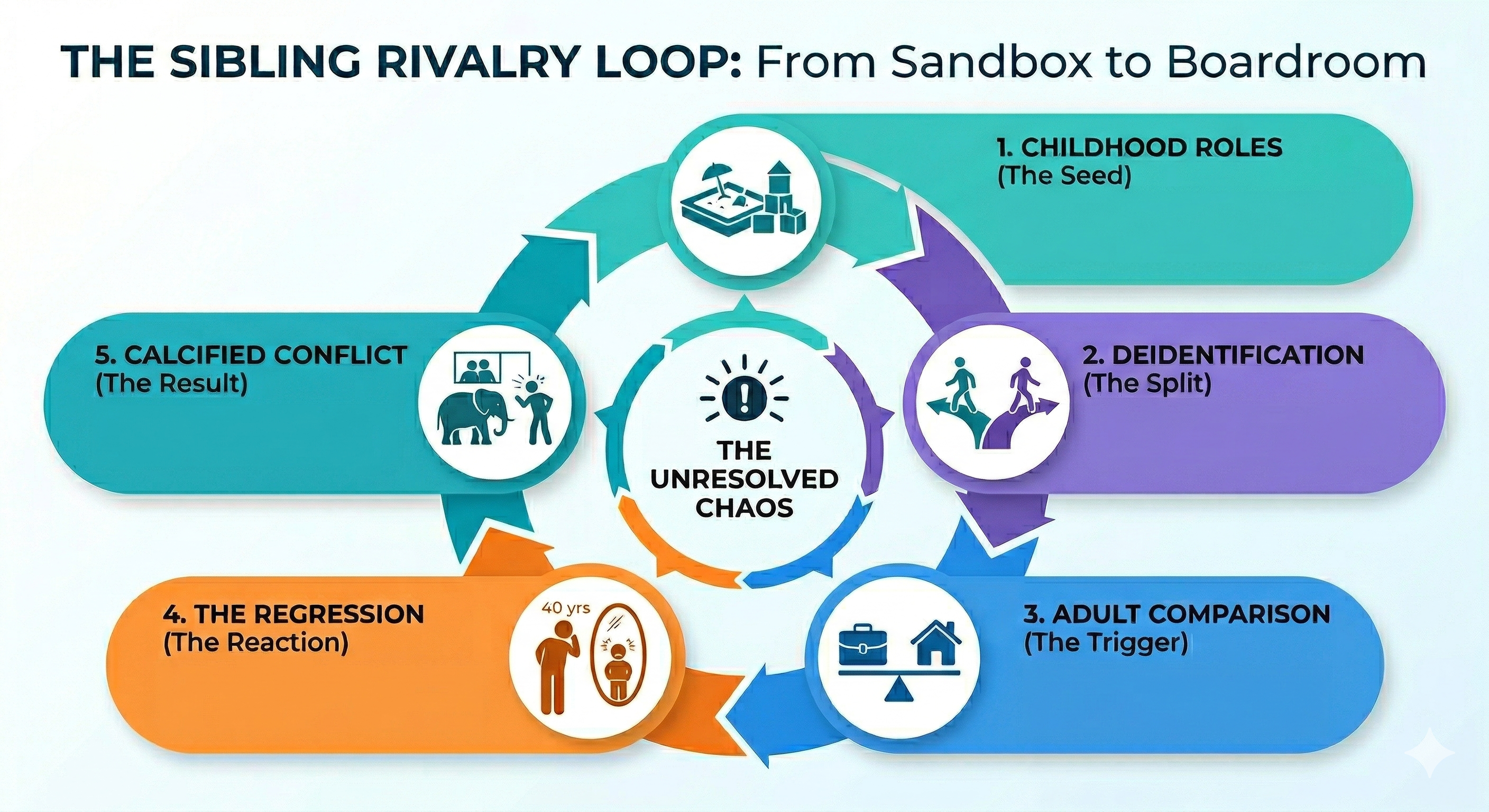
One sibling becomes the “successful one,” while another is the “responsible one,” the “rebellious one,” or the “creative one.” Everyday conversations start to carry an undercurrent of evaluation, and random events trigger insecurities about how you measure up.
@jackiekeyacoachHow else does adult sibling rivalry show up during festive family gatherings?♬ original sound – jackiekeyacoach
Because these happenings are subtle, the conversations are difficult. Unfortunately, if these roles are never questioned or consciously dismantled, they calcify over time and become an enduring elephant in the room of your relationship, fueling sibling fights. Even if they don’t reflect the complexity of who each person has become as an adult, it still becomes difficult to redefine those identities.
Real-Life Insight: The Cycle of Sibling Rivalry
Sibling relationships are among the longest we will ever have, and they carry layers of shared history and unresolved emotions. Tension with your sibling can feel isolating, especially when it seems like everyone else has figured out how to build the perfect family bond, but that’s not necessarily true.
According to the BBC, a OnePoll survey of 2,000 adults found that over 50% still argue and compete with their siblings. For about 15%, the rivalry has motivated them to get ahead in their careers and achieve more in their lives. But for another 20%, they still bring up the childish debate about who their parents’ favorite is.

Image credits: Guillermo Spelucin / Getty Image
If your relationship with your sibling sometimes leaves you feeling confused, frustrated, or even guilty for wanting distance, take a moment to breathe. These feelings are far more common than people like to admit.
Some real stories of sibling conflict that parents shared with Bored Panda highlight the humorously trivial beginnings to this rivalry. Siblings start by arguing over who the cat loves more, whose blood tastes better to the mosquitoes, how to use their imaginary pool, or who gets to use the new Swiffer first.

Image credits: aliaynusz
On the surface, these disagreements seem like insignificant childish squabbles. But if handled poorly, the emotional reactions they trigger can become much stronger than the situation warrants. Underneath that argument about a balloon or a game of tag, it’s about fairness, respect, and the familiar emotional roles they’re now learning as they grow up.

Image credits: lmegordon
When the same tensions repeat year after year without being resolved, they can gradually reshape the relationship in more serious ways. A more concerning collection of sibling stories highlights people whose rivalry got so bad that they disowned their siblings.
Years of manipulation, constant disrespect, and repeated betrayal from siblings who interfered with their marriages, spread harmful rumors, mistreated their children, or even exploited them financially led these people to set aside decades of history and cut contact.
When you compare the two sets of stories, a sobering pattern emerges. The petty fights that seem harmless in childhood center on fairness, attention, and respect. If those issues remain unresolved, the conflicts don’t simply disappear as siblings grow older. Instead, they evolve alongside adult responsibilities, relationships, and pressures.
A childhood argument over who gets the vacuum can turn into a fight over control of family decisions. Competition over grades can transform into comparisons about careers, and the teasing that once felt playful can harden into resentment.
Now, before you spiral, remember that not every sibling rivalry is destined to end in estrangement. But the core idea is that the frustration you feel isn’t irrational or overly sensitive. In many cases, it’s your mind recognizing a long-standing pattern that deserves attention before it grows into something far more difficult to repair.
How to Heal the Rift (or Keep the Peace)
Managing sibling rivalry often requires taking some time to pause and reflect. Understand the roots of your sibling rivalry, then decide what kind of relationship you want going forward.
Depending on how wide the chasm between you and your sibling is, there’s a chance you may never work your way back to a close friendship, and that’s okay. You may not be able to rewrite decades of history overnight, but you can create a dynamic that allows both of you to coexist healthily and with less tension.
@unlicensedadvice Sibling rivalries can continue into adulthood, and here’s why. #podcastclips#siblingrivalry#siblings#podcastforwomen#podcaststories#fyp#adviceforwomen♬ original sound – Unlicensed 💌
- Acknowledge the baggage: Admit that you are both reacting to the past, not just the present.
- Shift the focus: Talk about your current life, not your childhood roles.
- Set boundaries: Decide which topics (money, parenting, inheritance) are off-limits for now.
Therapists at Utah State University advise that the best approach is to make a small first move. Don’t leap into the deep end with a long, reflective essay analysing every old argument or trauma-dumping on them. Just start out with a card, text, or email that says “I’m thinking about you.”
Take some time to have normal conversations where you show that you care about them, then bring up your thoughts. Make it a calm discussion about the patterns in your relationship, not individual incidents where you both can get lost in the details of who did what.
Of course, these conversations don’t always go perfectly. Your sibling may feel defensive, dismissive, or surprised by what you say. But even if the discussion isn’t immediately productive, expressing your perspective calmly can still shift the tone of the relationship somewhat.
Naturally, you might want your sibling to finally admit they were unfair, acknowledge your accomplishments, or recognize how their behavior affected you growing up. But one of the most difficult but liberating realizations in here is that you may never get the validation you’re hoping for, so you need to let go of the need to “win” the conversation.
It’s a bitter pill to swallow, but you may need to choose peace and compromise over proving a point. Because sibling conflicts are so deeply layered, the chances are that you’ll never get a clear resolution. If you make this into a quest to force them to agree with you, you might stay perpetually trapped in the same rivalry that started decades ago.
If you want to maintain contact without constantly reigniting conflict, it can help to keep your interactions simple. If topics like childhood favoritism, family finances, or politics place tension on your relationship, avoid them as much as you can. It’s not cowardly or superficial to make concessions to keep the relationship alive.
You could even loop them in by setting clear boundaries about what you’re willing to discuss with them. Make your limits clear and consistently enforce them to affirm which topics or behaviors will no longer be part of your relationship.
Recognizing the Toxicity vs. Normal Friction
Crucial Note: Normal rivalry is annoying; toxicity is damaging. If a sibling consistently sabotages your joy or mental health, distance isn’t “immature” – it’s a necessary boundary.
Healing the rift with your sibling goes beyond wanting not to be annoyed by them. A 2019 research paper in the Journal of Family Psychology studying over 600 elderly adults found that those who had conflict with their siblings were more likely to experience anxiety, depression, loneliness, and social isolation, even in other social circles. These people were found to be more likely to lack the social support needed to maintain their well-being as they aged, leading to declines in their physical health.
So, in spite of the fact that adulthood is possibly the busiest you’ll ever be, it’s still the most crucial time to fix your sibling dynamic. But at this point, it’s important to pause and ask a difficult question: Is your sibling relationship simply experiencing normal friction, or has it crossed the line into something unhealthy?
When two people with strong personalities share decades of history, occasional clashes are inevitable. You and your sibling might disagree about politics, lifestyle choices, or how to handle family responsibilities. They probably have habits that irritate you, but let’s face it — you probably irritate them just as much. That’s frustrating but manageable tension.

Image credits: rawpixel.com / Freepik
But when the pattern goes beyond irritation and into consistent harm, alarm bells start to ring. Instead of disagreements that eventually cool off, if your sibling seems to be manipulative, repeatedly invalidates you, undermines your autonomy, sabotages your relationships, or constantly leaves you feeling anxious and emotionally drained, you need to have a different conversation.
A toxic sibling relationship is no small matter. A 2013 paper in the Journal of Agression, Conflict and Peace Research found that psychological and physical sibling violence is the most prevalent form of family violence, particularly if your parents were violent towards the kids. If this is what you’re dealing with, you’ll need to go beyond regular conflict resolution.
Whether or not your sibling relationship is bordering on toxicity, it’s important to realise that repairing the relationship isn’t always entirely within your control because healthy reconciliation will require effort from both sides.
If your sibling is insistent on hurting, humiliating, or destabilizing you, your goal has to shift from fixing the relationship to protecting your well-being. That means setting boundaries, refusing to participate in harmful patterns, stepping away from destructive conversations, and restricting how much emotional access they have to you.
Society frames family relationships as unconditional, so many people feel guilty for creating emotional distance from a sibling. It’s important to understand that stepping back from the rivalry does not mean you’ve stopped caring. But in a situation where the relationship is harmful to you, protecting your peace is more of an act of self-respect than rejecting your family.
When To Seek Professional Help
If sibling conflict is affecting your mental health, work performance, or other relationships, therapy can help, whether individually or as a family. It’s especially worth considering when the relationship involves manipulation, repeated emotional harm, or any form of violence.
Conclusion
Growing up together creates a powerful, complicated bond built on years of memories, roles, and expectations that formed long before either of you had the maturity to understand them. Changing that history can be frustratingly slow, but it’s worth the work.
Before you set out, it’s important to face the reality that no amount of explaining, arguing, or revisiting the past can change your sibling. Even if you’re one of the lucky few who get that coveted moment of validation, your healing won’t come from that. It’ll come from building a relationship where the past no longer dominates every interaction.
They might still drive you crazy, but now, you can understand them, communicate how you feel, and ease into releasing the tensions of adulthood to simply be siblings again.
FAQ
Is it possible for sibling rivalry to just fade away?
Healthy sibling rivalry can fade away, but deep-seated conflict often leaves a lasting undercurrent into adulthood unless you consciously address it.
Is sibling rivalry normal in adulthood?
Can sibling rivalry cause anxiety or depression?
When should siblings consider cutting contact?
Cutting contact is a personal decision, but it may be worth considering if the relationship involves consistent manipulation, abuse, or repeated harm that continues despite clear boundaries.
How do I deal with a toxic sibling?
Start by identifying the patterns rather than reacting to individual incidents. Set clear, consistent boundaries. If the relationship continues to affect your mental health, professional therapy can help.
Is it possible to fix a sibling relationship after years of conflict?
It’s possible, but it requires effort from both sides. You can’t force reconciliation, but you can change how you show up in the relationship and where you draw the line.
📢 Gostou da notícia? Compartilhe com os amigos!
Este artigo é uma tradução automática de uma fonte original. Para ler o conteúdo na íntegra: Clique aqui.