
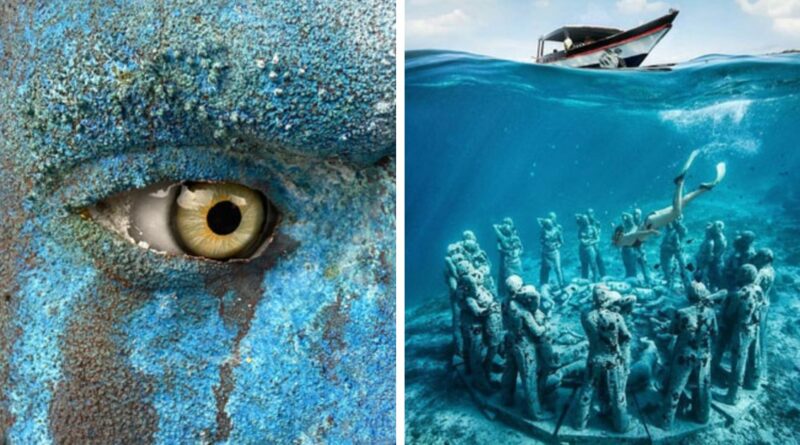
🤯 INCRÍVEL: 40 Underwater Sculptures That Turn The Ocean Into An Art Gallery While Helping Marine Life 😲
Jason deCaires Taylor is the British artist behind the world’s first underwater sculpture park, a groundbreaking project that helped expand ideas of how public art can exist within natural environments. Over the past two decades, he has created more than 1,200 public sculptures across land, tidal zones, and fully submerged locations around the world, drawing thousands of visitors each week. His large-scale, site-specific installations are most often placed beneath the surface or along changing shorelines, where art meets the rhythms of the sea.
Taylor’s sculptures are made from pH-neutral, environmentally sensitive materials designed to encourage coral growth and support marine life. As currents, algae, and time gradually transform each piece, the works become living monuments to decay, renewal, and metamorphosis. Through them, the artist invites us to confront ocean pollution, climate damage, and our shared responsibility to leave a healthier world for future generations.
More info: underwatersculpture.com | Instagram | Facebook
Over the years, Taylor has earned recognition not only for his incredibly beautiful sculptures, but for the larger impact of his work. He is a fellow of The Royal Society of Sculptors, serves as an Ocean Ambassador for Divers Alert Network, and has been praised for combining creativity with environmental leadership. Publications such as Fast Company and Global Leaders Today have highlighted his influence, while Foreign Policy honored him with the Global Thinker Award. Some have even called him the Jacques Cousteau of the art world, a fitting comparison for someone who has turned the ocean itself into a place of wonder and reflection.
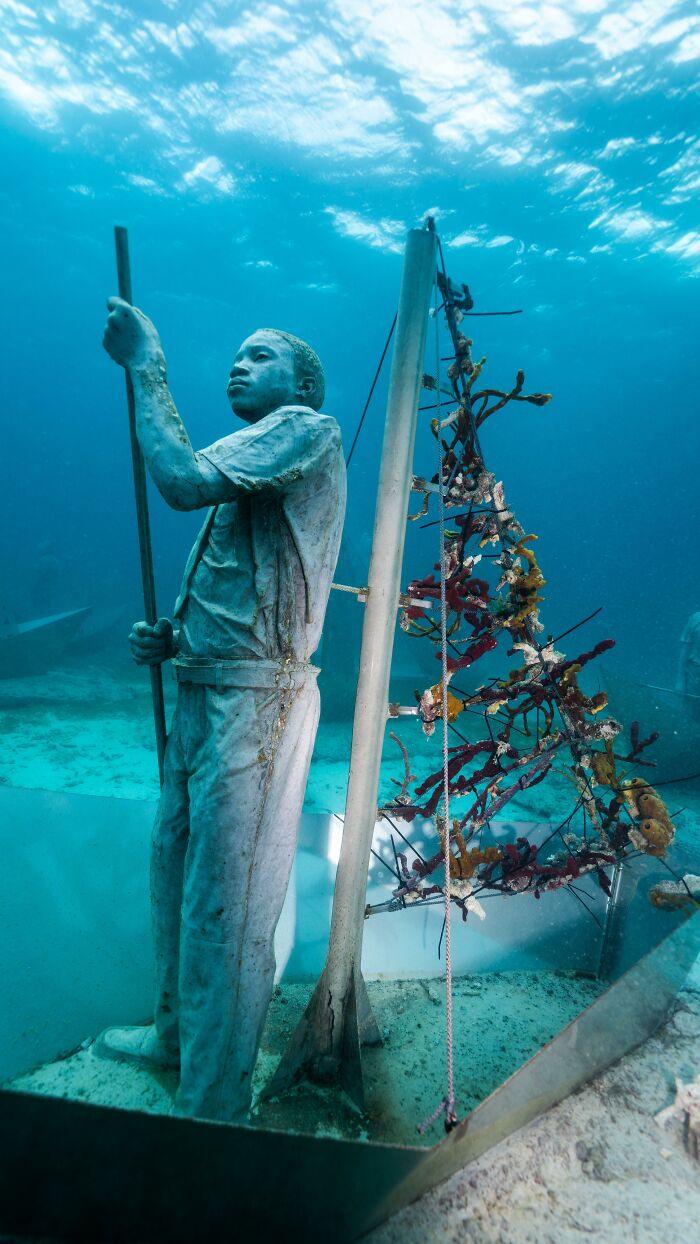
Nestled in the pristine northern waters of Grenada, the islands of Carriacou and Petite Martinique have long been celebrated for their natural beauty and vibrant culture. Yet these islands have also become emblematic of the urgent realities of climate change—a truth devastatingly underscored in July 2024, when Hurricane Beryl, a Category 5 storm, left the islands reeling from its destructive force.
The underwater museum A World Adrift was initiated in 2023 to highlight the unique vulnerabilities of Small Island Developing States (SIDS) to rising sea levels, warming oceans, coastal erosion, and the mounting threat of extreme weather events. Tragically, the installation has now become a living testament to these themes, as the effects of climate change unfolded in real time, midway through the project.
A World Adrift showcases an evocative fleet of 30 boat sculptures, each navigated by a local schoolchild, symbolising the uncertain waters of the future. These young figures, depicted as climate refugees, are not only poignant reminders of the generational stakes of climate change but also embody resilience, hope, and defiance.
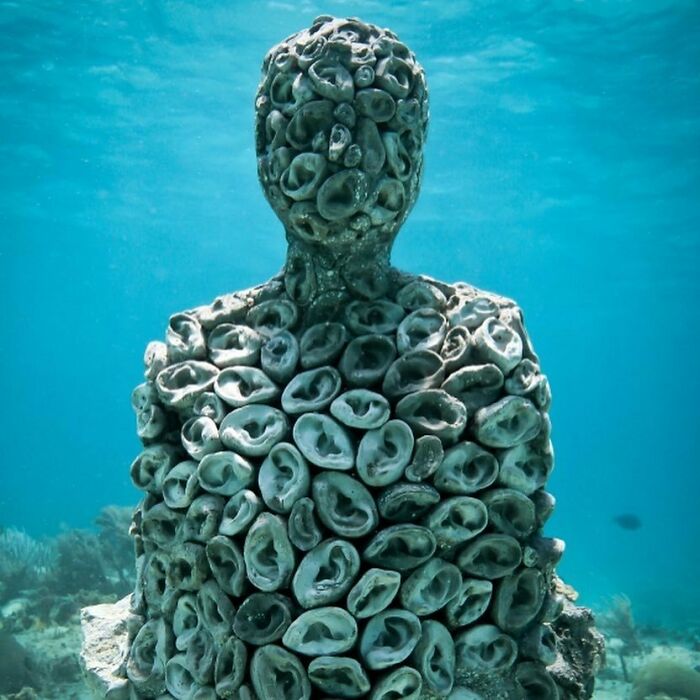
The Listener is installed in Cancun, Mexico at 3m deep. It is made from the casts of ears from local school children. Built into the structure is an underwater microphone and hard drive which is constantly monitoring ambient noise. A team of marine biologists are downloading the data and have realized that the silent world is actually not that silent and some studies even suggest that coral polyps navigate by using sound. The work aims to engage the local community in reef conservation and present a new way to combine science and art.
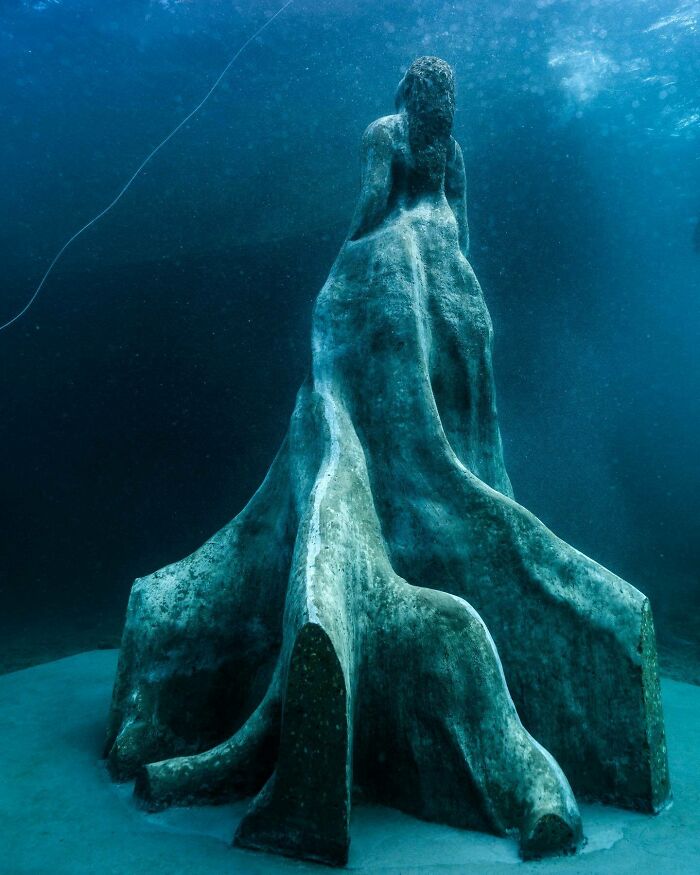
Jayme Marshall represents the next generation of Indigenous leaders. Her sculpture highlights the role Traditional Owners play in protecting the future of the Great Barrier Reef and surrounding Sea Country. Miss Marshall’s involvement in the project emphasizes how stories and traditions of the reef are passed down through generations and still hold significant weight within Indigenous culture to this day. Her form references the roots from a Mangrove and Bayan Tree.
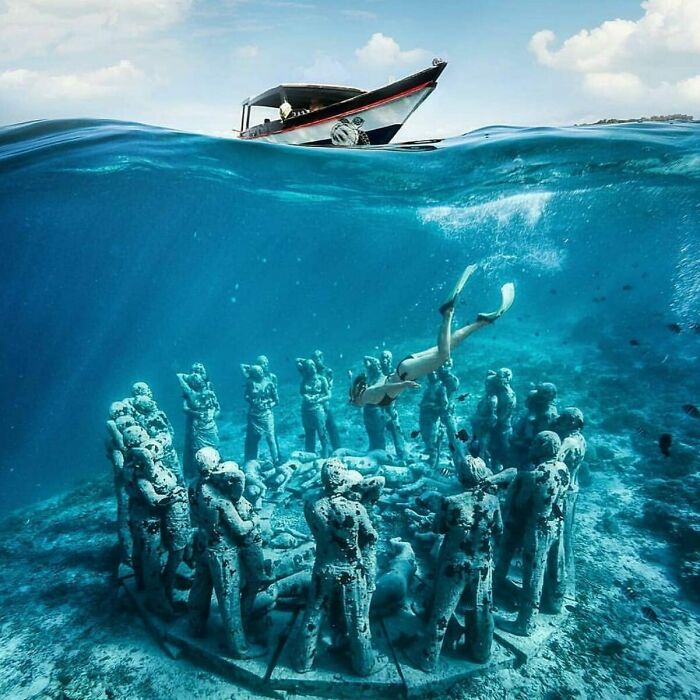
Nest depicts a circle of 48 life-size figures off the coast of Gili Meno, a small island between Bali and Lombok in Indonesia that is famed for its crystal clear waters and turtle population.
In the hauntingly beautiful work, embracing couples encircle yet more figures curled up on the seafloor. The circular formation evokes time and continuum. The interlocking pieces connect to provide a platform for marine life to colonize and inhabit.
Forty per cent of the world’s coral reefs have been lost over the past few decades, and scientists predict more is now at risk. Nest aims to remind visitors of the many fragile treasures beneath the sea.
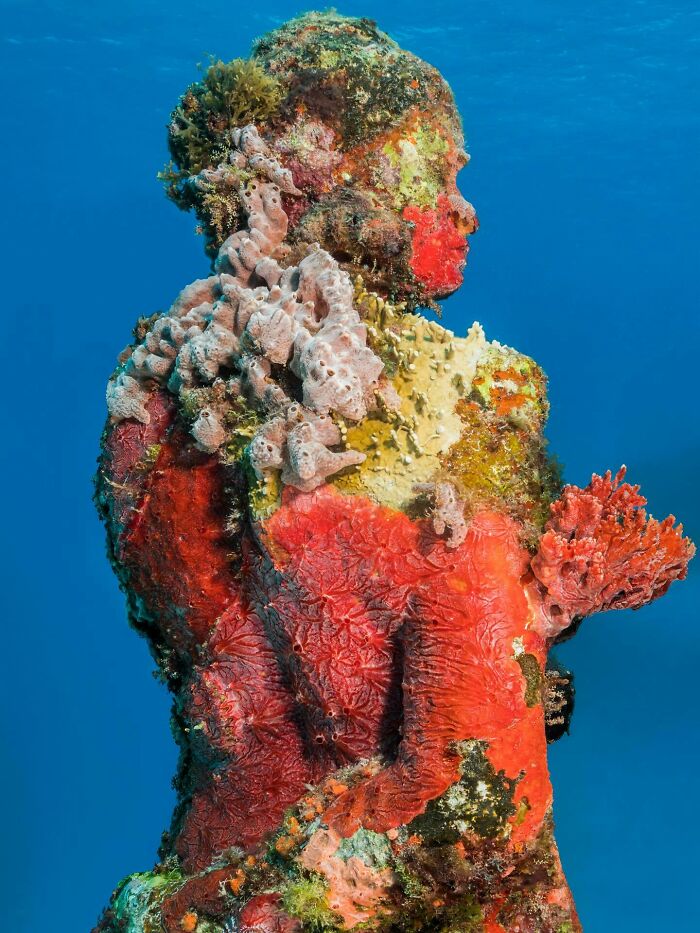
Enveloped by red sponges and fire coral, these sculptures are fifteen years beneath the waves, slowly claimed by the sea.
Molinere Bay Underwater Sculpture Park was the first of Jason deCaires Taylor’s underwater gardens. It was widely acclaimed as the first of its kind. The site is now listed as one of National Geographic’s 25 Wonders of the World.
The 75 works cover an area of 800 square meters and are located in a series of sand patches and gullies between natural rock formations. At depths of 5-8 meters, they are accessible by scuba diving, snorkeling, and glass-bottom boats, with departures from St. Georges and Grand Anse, both a short boat ride away.
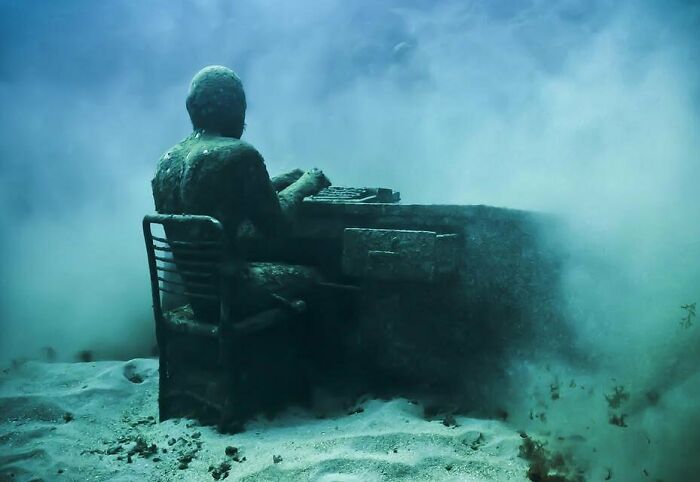
The Lost Correspondent portrays a man sitting at a desk with his typewriter. A collection of newspaper articles, dating back to the 1970s, covers the desktop, some of them reporting stories from a time in Grenada’s history before the revolution. The piece reflects on how communications are changing so rapidly.
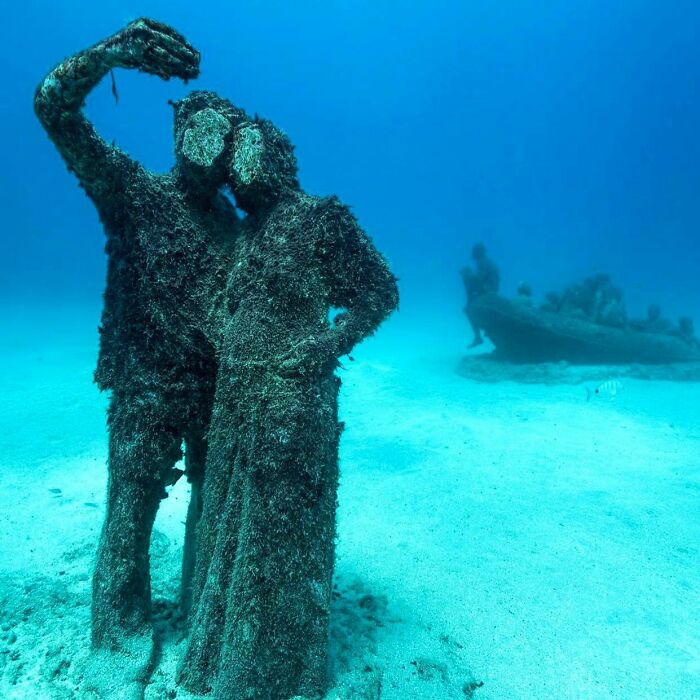
Museo Atlántico is the first underwater art museum in Europe and the Atlantic Ocean. It is situated within Lanzarote’s UNESCO World Biosphere Reserve and is accessible to divers and snorkelers. The monumental project took over three years to plan and construct and includes over 300 life-size casts placed on an area of previously barren seabed of 50m x 50m.
Crossing the Rubicon features 35 people walking towards an underwater wall, unaware that they are heading to a point of no return. They are looking down or at their phones, in an almost dreamlike state. This is a recurrent theme in Taylor’s work – we are sleepwalking towards catastrophe, unable to take stock of our own impact on the natural world and therefore our own survival.
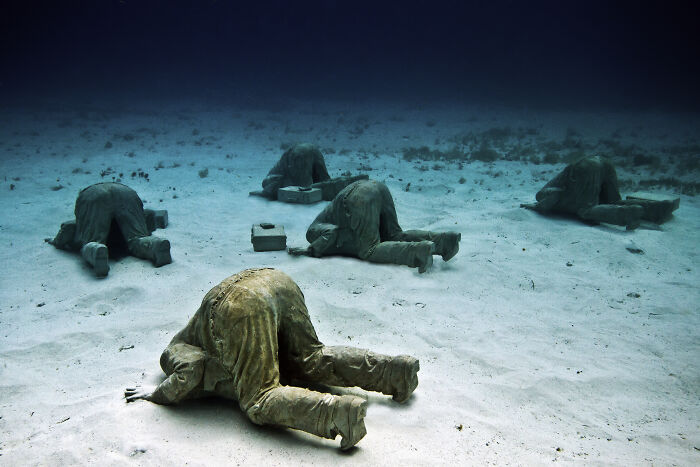
The Bankers (originally titled The Politicians) were designed to provoke thought and highlight urgent environmental and societal concerns.
Six men kneel on the ocean floor, their heads buried in the sand, briefcases by their sides, and their buttocks pointing skyward.
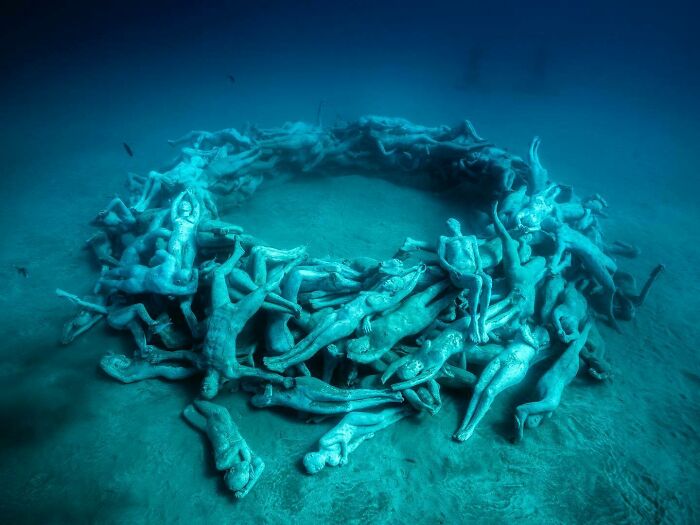
The Human Gyre consists of over 200 life-size human figures in an oceanic gyre. The piece embodies our naked vulnerability to the ocean’s inherent power, and our fragility in the face of its cycles and immense force. It provides the oxygen we breathe, it regulates our climate, and it provides a vital source of nutrition to millions of people.
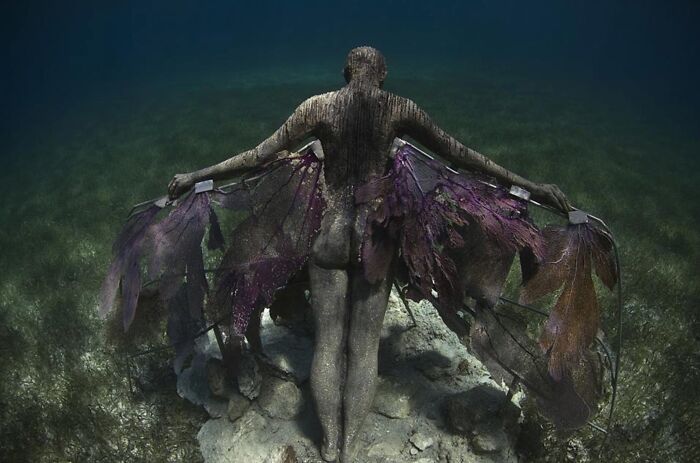
Reclamation sees an angel with her back arched, her face and hands lifted towards the heavens as if in divine reverence. Her wings are formed of Gorgonian sea fans rescued from the seabed after storm damage.
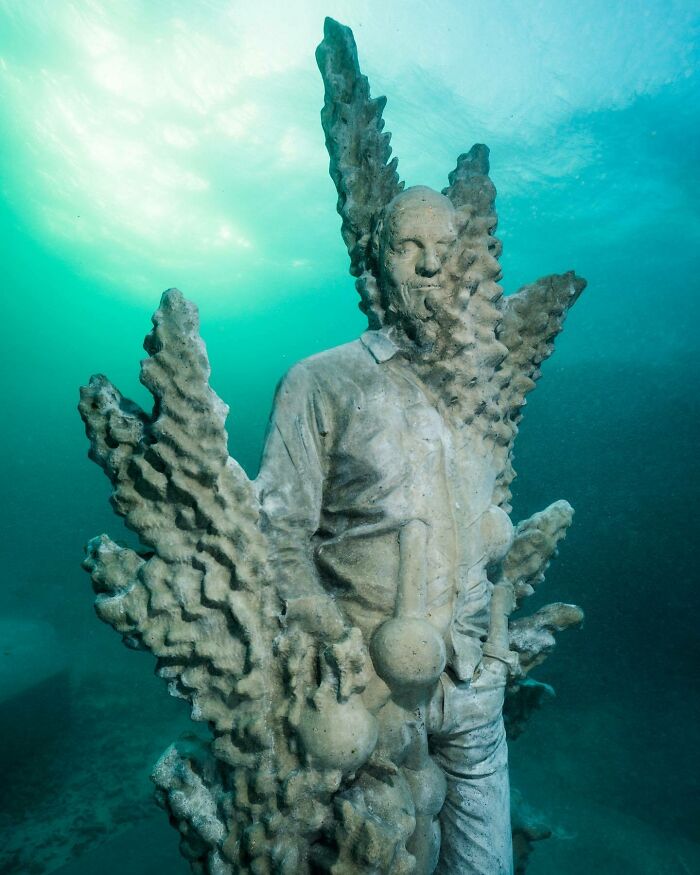
In 1981 while driving in Geoffrey Bay on Magnetic Island, Professor Peter Harrison witnessed the phenomenon of what is now known as mass coral spawning and was the first to record the event. Professor Harrison has gone on to pioneer a world-first technique dubbed ‘coral IVF’, whereby millions of coral sperm and eggs are captured during coral spawning and left to form into larvae in floating pools on the reef. Once the larvae are ready to settle, they are released onto damaged areas of the reef to help them recover.
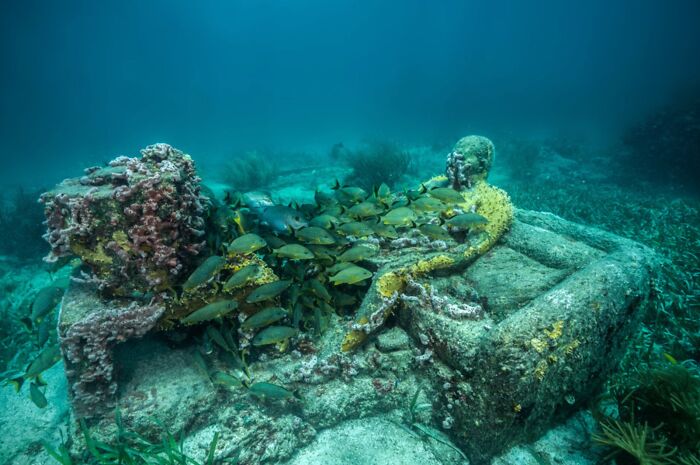
Inertia depicts a life-size human figure sitting on a couch, absorbed in watching television, representing modern-day complacency and passive consumption. Surrounding objects emphasise detachment from environmental realities and the over reliance on comfort and convenience.
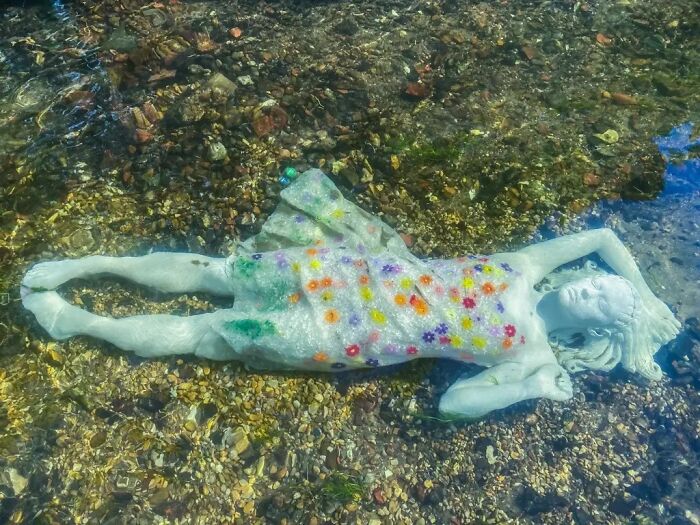
Beneath Canterbury’s historic Westgate Bridge, nestled into the shifting bed of the River Stour, Alluvia is part artwork, part environmental sentinel. Crafted from reclaimed glass fragments and marine-grade stainless steel, and embedded with subtle LED illumination, the work also incorporates environmental monitoring sensors and glows from within at night.
The work draws reference to Sir John Everett Millais’s celebrated painting Ophelia (1851-1852). A character from Shakespeare’s Hamlet which some scholars have suggested could have been inspired by a 16th century drowning which took place on the river stour in Canterbury. The title Alluvia refers to the alluvial deposits of sand (silica), linking the work’s material—glass, aderivative of silica—to the natural process of sediment left behind by the river’s rising and fallingwater levels.
The figure’s streamlined posture responds to the river’s flow, reflecting both its ceaseless movement and the invisible barrier of water—like an image or memory trapped behind a window. Over time, the river’s volume swells and recedes with the seasons, and nature begins to collaborate with the work, reeds clutch at its form and algae colonises its surface.
This slow transformation turns Alluvia into a living artwork—one that resists inertia and invites the viewer to reconsider permanence, presence, and perception. In this constant state of flux, we are reminded that memory, like the river, is never still—always refracting, reshaping, and often retreating just beyond reach.
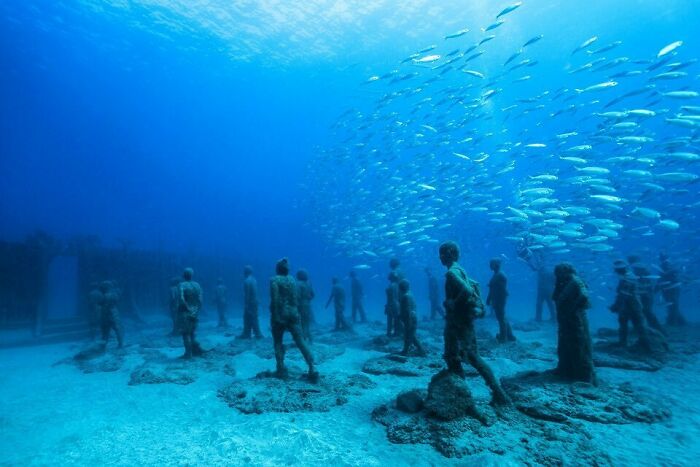
Featuring 35 life size people walking towards a doorway in an underwater wall, it references the climate emergency and the window of opportunity we have to enact change before we reach a critical point of no return. The wall itself stretches 30 meters long, 4 meters high and contains a single rectangular doorway at its centre. It is intended to be a monument of absurdity, a dysfunctional barrier in the middle of a vast fluid three-dimensional space, which can be bypassed in any direction. It emphasises
that notions of ownership and territory are irrelevant to the natural world. In times of increasing patriotism and environmental destruction, the wall reminds us that we cannot segregate our oceans, air,
climate or wildlife as we do our land and possessions. We forget we are all an integral part of a living system at our peril.
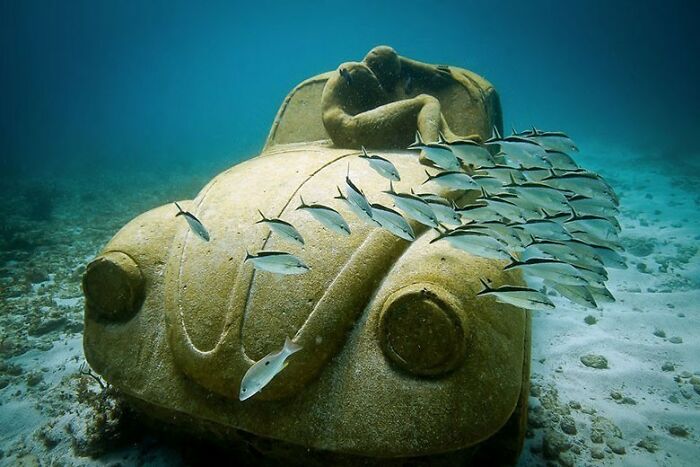
Anthropocene is a cast of a VW Beetle with a mourning child on the windshield. The piece asks what we are leaving to future generations. The nine-tonne sculpture is also specially designed to create a habitat for crustaceans such as lobsters and its thick concrete walls prevent them from being extracted by local fisherman’s hooked barbs.
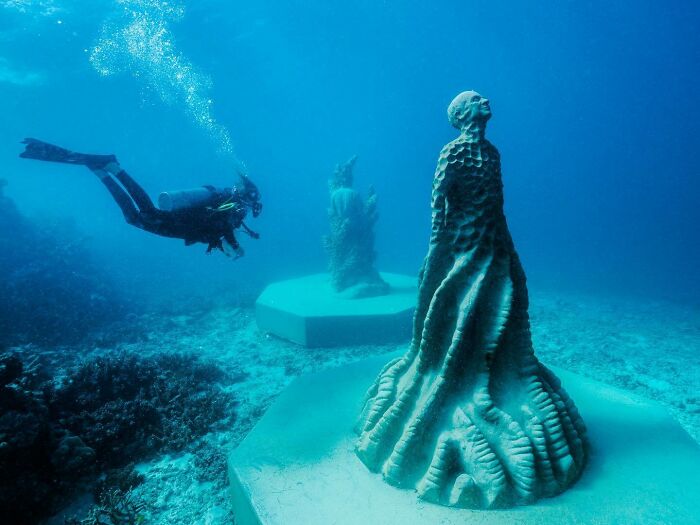
Professor John “Charlie” Veron is an acclaimed marine scientist who has dedicated his life to charting the world’s coral reefs and his known as the ‘Godfather of Coral’. He has discovered and described 20% of all coral species on the globe, and was awarded the Darwin Medal for his work on evolution. He was the first full-time researcher on the Great Barrier Reef, held the title of Chief Scientist at the Australian Institute of Marine Science (AIMS), and he is currently working on the bold plan of collecting 400 species of coral from the Great Barrier Reef to preserve in a biobank.
Sculpture hybrid human, pectinia/brain coral form.
📢 Gostou da notícia? Compartilhe com os amigos!
Este artigo é uma tradução automática de uma fonte original. Para ler o conteúdo na íntegra: Clique aqui.