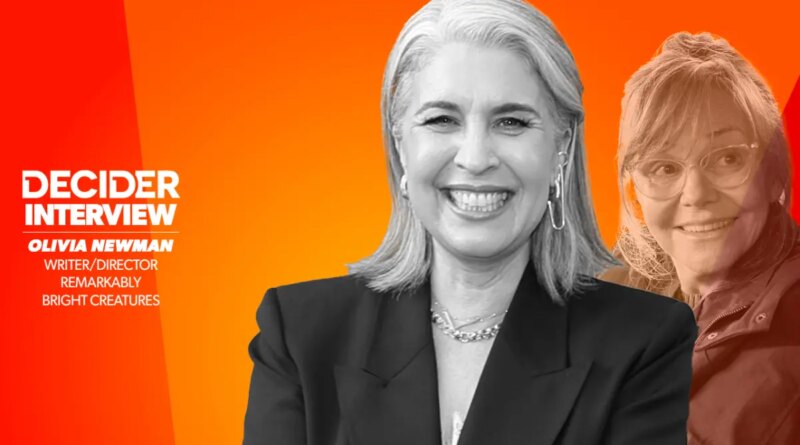
NÃO PERCA: ‘Remarkably Bright Creatures’ Director Olivia Newman Explains How Losing Her Home in the LA Fires Gave Her a “Personal Insight” on the Netflix Movie 🍿
Five days before director Olivia Newman began prep for Netflix’s Remarkably Bright Creatures movie—which began streaming today—she lost her home in the Los Angeles’s Eaton Fire.
“After losing my own home, I had a different understanding of what that attachment to home actually means,” Newman told Decider in a recent Zoom interview. “It’s really about the history that is connected to objects in your house.”
Loss, grief, and leaving one’s home happens to be a major theme in Remarkably Bright Creatures. Alongside co-writer John Whittington, Newman adapted the script from the best-selling 2022 novel by Shelby Van Pelt, about a lonely widow named Tova (Sally Field, also an executive producer on the film), who is still grappling with the death of her son, decades later. She finds comfort in speaking to giant octopus, Marcellus, at the aquarium where she works as a cleaning lady. Marcellus can’t speak back, but the audience hears his thoughts via a delightful voice-over narration provided by Alfred Molina. With a little help from Marcellus and a new friend, played by Lewis Pullman, Tova navigates through her grief and faces the difficult decision of whether to leave behind the home where she raised her son.
Newman—also known for directing another book-to-movie adaptation, Where the Crawdads Sing—spoke to Decider about working with Shelby Van Pelt (also a producer on the film) to adapt the novel for the screen, the real octopus that inspired Marcellus’s design, and how losing her home in the LA fires changed her perspective on the story.

DECIDER: I read that Sally Field, who was already cast when you came on board, had some input on the screenplay. Can you tell me a little bit about that collaboration, what notes Sally had on her character?
OLIVIA NEWMAN: When I joined the project, Sally was already attached. The producers had first brought the book to Sally. She signed on right away. She knew it was a story that she wanted to be involved in. John Whittington wrote the first drafts of the script, and then I signed on to direct and took my stab at taking on the adaptation process. Sally was involved in every draft of the script. She read every draft. She gave us great notes.
So much of her notes were about making sure we weren’t losing too much of what’s in the book. Making sure that the things that really mattered to her—in terms of Tova’s character, her motivations, and her relationships with Cameron and with Ethan—that they were preserved from what is so beautifully described in the book. It was a fluid back and forth. Even as we were shooting, we would find things, sometimes, on the day—when we were working through a scene, if something wasn’t working, we would improvise, we would noodle, and we would find it in the moment. She’s such an incredible comedic actress, too. We wanted to make sure that the comedy was able to play organically. There was a lot of ad-libbing and improvising. We would find jokes that weren’t necessarily even written in.
I know it was a while ago, but can you remember anything specific that was important to Sally to keep from the book?
What was important was to understand that Tova has not gotten over the death of her son. There’s a lot of guilt that weighs on her. To not lose track of that thread. There was a way that you could have told this story that leaned more into mystery— had Tova actively investigating a mystery. But we all felt strongly that it was more of an emotional story. The mystery had more to do with the emotional story line, of what is it that she can’t let go of, rather than having her [go on] an actual investigation. So, keeping it psychological and emotional rather than turning it into a different genre.

Shelby Van Pelt, the book author, was also a producer on the film. Tell me about that collaboration. Were there any changes you guys were considering that Shelby knew it was important to book fans to keep?
Shelby was an amazing resource and support. She also read every draft of the script and would give us notes. They were often very minimal, but little details like—you wouldn’t necessarily hear thunder in the Pacific Northwest if it’s not a huge storm. She would catch little things that she might not have realized were that big of a deal, but were important to me as a filmmaker to make sure that we were being accurate. Things that she knew book fans really loved— they really love that Tova returns the Grateful Dead t-shirt to Ethan at the end of the book. That had gotten lost for for a while during the drafts of the script. Shelby said, “You know, I think that they’re going to miss that, if we can’t get that back in.” So we found a way to to bring that back in.
She was incredibly supportive and understood that the movie version of the book was going to have to take some creative liberties, and be different than the book. But always understood that our goal was to maintain the DNA of the book and the characters, and make sure that those rang true.
What significant changes were made from the book, and why?
The book is written from—each chapter is a different character’s point of view. You have chapters where you’re with Cameron back in California, and you have chapters with Ethan and you get Ethan’s whole backstory. You’re bouncing between all of these different characters. We knew right away that we wanted Cameron and Tova’s stories to intersect and affect one another. In the book, they’re sort of running parallel stories, until very late in the book. They don’t start to affect one another until close to the end. The biggest structural challenge was: How do we get these two people interacting, and affecting one another, right away? [How do we we] have that be the engine of the movie rather than jumping around between characters.

It’s my understanding that Marcellus the Octopus was mostly VFX. He looks so realistic to me. Were there any practical props used for the scenes when he escapes his cage? Was his design based on any particular real life octopus?
Very early on, we learned that there was no way we were going to be able to train an octopus to do all the very specific blocking that we needed in the movie. We settled on creating a CGI version of Marcellus. But we wanted it to be as photo real as possible, so that we could also shoot a real giant Pacific octopus named Agnetha, who lives at the Vancouver Aquarium. What we did was we took hours of footage of Agnetha in her tank, so that we could study octopus behavior, and create an exact replica of Agnetha. [We used] footage of Agnetha interchangeably in the movie, with our CGI. Agnetha does appear in the movie. I won’t tell you what’s real and what CGI, because the goal was to not know.
We built a replica of Agnetha’s tank on our set. We had puppets made that were the same reddish tone of Agnetha, for lighting reference, for our DP, that we could put into the tank. Also for eye line, for the actors, but mostly as a lighting reference. We had another puppet that had some weight to it, and was more malleable, if we needed to give the actors something to feel and hold. So they understood what the octopus felt like, and moved like. They could play with that.
But we always had to do takes with absolutely nothing in it. That required a lot of imagination on the part of the actors, to picture what the octopus was doing. We would talk about it, describe what the blocking was. We would give them eye lines for how the octopus was moving, and where it was going. Then it was in the hands of our amazing actors to visualize it, imagine it, and do it with absolutely nothing in their hands.
How is Agnetha doing? Can folks visit her at the Vancouver Aquarium?
Agnetha has outgrown her small tank and was put into the bigger tank. In fact, when we shot her, she was already on the verge of needing to move into a bigger tank. I don’t know if she is still in the large tank, or if she has passed. Unfortunately, giant Pacific octopus only live up to four years, if they’re lucky. But they always have octopuses at that aquarium. If Agnetha is not there, there would be another one in her place.
[Decider reached out to The Vancouver Aquarium, who confirmed that Agnetha the octopus is still alive!]
I love that Alfred Molina is the voice of Marcellus, famously Doctor Octopus from Spider-Man. Tell me about casting Alfred. Was that part of the reason you guys went with him?
[Laughs.] No, it was not necessarily because of that role. We thought of Alfred because we wanted somebody who could sound both very intelligent—very haughty and snarky—but also bring a warmth and heart to the character. It was important to me that Marcellus sound like he was from the Pacific Northwest, not from England [where Molina is from]. We talked a lot about accent and how we wanted him to sound. I thought Alfred doing an American accent would give the octopus both a sense of like being from that part of the country, but also, if it isn’t exactly American, it’s also interesting because we don’t really know what a Pacific Northwestern, English-speaking octopus sounds like. We wanted it to fall somewhere in between.
Alfred’s ability to give Marcellus his own arc in the movie—to start off as someone who can just barely tolerate humans, to becoming really invested in Tova and in Cameron, to the point where he truly loves them, and is willing to sacrifice for them. Only an actor of the caliber of Alfred Molina could show us all of that, just through his voice work.

You wrote in your director’s statement that you lost some people in your life, and your home to the L.A. fires right before heading into prep for this movie. I’m very sorry that happened. How did those losses approach affect your approach to a movie that is about loss?
I was dealing with a lot. My mother-in-law was having a lot of health issues when I was working on this script and then prepping the movie. I was very much in that world of trying to help people figure out the best living situation—whether to move, or stay in their home. That agony of leaving one’s home. I really understood why [Tova] preferred to stay home, even when it wasn’t necessarily the best option for her health needs.
After losing my own home, I had a different understanding of what that attachment to home actually means. I came to understand that it’s really about the history that is connected to objects in your house. It’s not the value of them. It’s a napkin holder that belonged to your grandmother—every time you use it, you tell your kids a story about this person who’s no longer in your life. Being surrounded by the ghosts of people who mean so much to you. That is what you fill your home with. To lose that, suddenly, I had a different understanding of why it was so hard for my mother-in-law, why it’s so hard for Tova, to imagine letting go of that house that holds so much memory, and so much attachment to people that she loved. It gave me a deeper and more personal insight into that experience.
This is Netflix is big Mother’s Day release. My mom loves My Octopus Teacher, which you also mentioned in your statement, and I know she’ll love this film. What is it about octopuses that people—and perhaps women and moms in particular—feel such a connection to?
I didn’t know that it was women and mothers that connects so much to octopuses. I think there is a fascination with them, because they are as close to an alien species as we can get on Earth. They make absolutely no sense in many ways. They are so intelligent. Being so close to a species that is so smart and yet could not be more different than how we are built, is absolutely fascinating.
Also, octopuses are generally very solitary creatures. They prefer to be alone. They navigate the world alone. What was really moving about My Octopus Teacher, and about this film, is seeing an octopus who actually opens up to another creature—and to a human being, of all creatures—and actually forms a relationship. Being able to see a creature that is normally so solitary break down and open up—much like Tova does in the movie—is something that we can all relate to. Those moments where we want to close off, and somebody else makes us open up and accept love.
📢 Gostou da notícia? Compartilhe com os amigos!
Este artigo é uma tradução automática de uma fonte original. Para ler o conteúdo na íntegra: Clique aqui.